AI Psychological Research Coalition

Continuous linework image of two abstract silhouettes of heads looking away from each other. Another line links between their minds, drawing the AIPHR logo in one of their minds. On one end of the thread connecting the heads is a circuit diagram and the other a single line.

The AI Psychological Research Coalition is a network of leading academic and professional institutions focused on gathering evidence, advancing research, and building a rigorous, evidence-based understanding of the psychological effects that AI systems are having on human health and wellbeing.

Our Affiliations

This research initiative is supported by a network of institutions committed to advancing psychological health and safety.

UNC logo, The University of North Carolina at Chapel Hill
Logo of the Center for Humane Technology
Fairplay logo - childhood beyond brands
Logo for Human Change, depicting a mother morphing into a robot holding a phone.

The Psychological Effects of AI: What the Research Is Showing

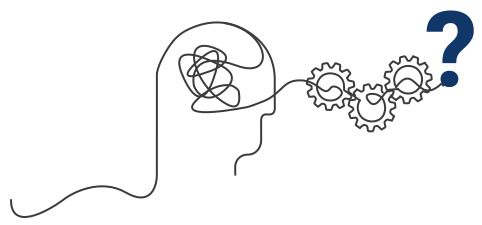
Continuous linework image of an abstract silhouette of a head with a line that passes through it and gets tied up, symbolizing mental health, the line continuous on the other side, forming cogs and ultimately a question mark.

Artificial intelligence is not just a tool. It has rapidly become a profound influence on how millions worldwide relate to technology, other people, and themselves.

While these technologies offer immense potential, their widespread adoption has also given rise to a new and complex set of psychological phenomena that require careful, objective study.

The psychological effects being documented span a wide spectrum. On the concerning end, clinicians and researchers are observing patterns that include compulsive use, cognitive dependency, identity disruption, emotional dysregulation, and in some cases, serious mental health impacts.

The full scope and nature of these effects remain under active study: How many people are affected, and in what ways? What role do individual differences play? Which groups may face greater risk — and which may benefit most?

Our Research

We are building a comprehensive, anonymized dataset to understand the evolving — and increasingly complex — relationship between humans and AI.

We provide a secure, anonymized system for submission of real-world accounts, including stories, screenshots, links, and chat logs.

Our mission is not to condemn AI technology, but to ensure its development is guided by a clear, evidence-based understanding of human psychological integrity.

Icon of document.

Document and understand the full range of psychological effects.

Icon of a a man reading text.

Support clinicians in recognizing and treating AI-related health conditions.

Icon of a magnifying glass Infront of shield.

Inform safer AI design and public policy.

Icon of a health plus symbol Infront of shield.

Help people use these tools in healthier, more sustainable ways.

Continuous linework image of an abstract woman using her laptop.

How to Submit your Research Contribution

Submissions are used exclusively for academic research. Participation is anonymous, voluntary, and takes about 10-15 minutes, and is open to adults ages 18 or older. You’ll be asked to share your experience and answer a few short questions.

We do not collect any personally identifiable information, and you should not include medical records or other sensitive data in your submission. The information you provide will be stored securely and will only be viewed by the research team.

By contributing to this initiative, you are helping to build a more informed, psychologically resilient future for everyone.

We recognize that many individuals are navigating this new landscape with a mix of curiosity, optimism, and concern — whether for themselves, their loved ones, or society at large.

Our work is grounded in the compassionate understanding that human well-being must remain at the core of technological advancement.
Submit Your Story, Securely and Anonymously

Your experience is a vital piece of the scientific puzzle. We have designed this platform to make your submission as simple and secure as possible. There are several types of information you can share. The submission form describes the types of data that are helpful for this research.

A single-line drawing of a left-pointing arrow intersecting with a shield, representing authenticity and verification.

Your submission could include:

Text icon of 3 lines of text

Chat Logs or Screenshots

 Easily upload files or paste text from your interactions.

Screenshot icon

Provide a Link

 Drop a link to a relevant public post, blog, or video.

Link attachment icon

Written Account

 Share your story or observation in your own words.

Behavioral Data Research Initiative

We seek to understand and address the emerging psychological effects of AI — particularly for the developing minds of children, adolescents, and other groups who may be especially susceptible — by informing the development of clinical tools and helping shape future AI technology and policy.

Have you noticed changes from using AI tools?

Have you or someone you know noticed changes — positive or negative — in behavior, mood, thinking patterns, or relationships following regular use of AI tools like ChatGPT or Gemini?

For questions or concerns about your rights as a research subject, please contact the Institutional Review Board at 919-966-3113 or by email to IRB_subjects@unc.edu.

Scroll to Top